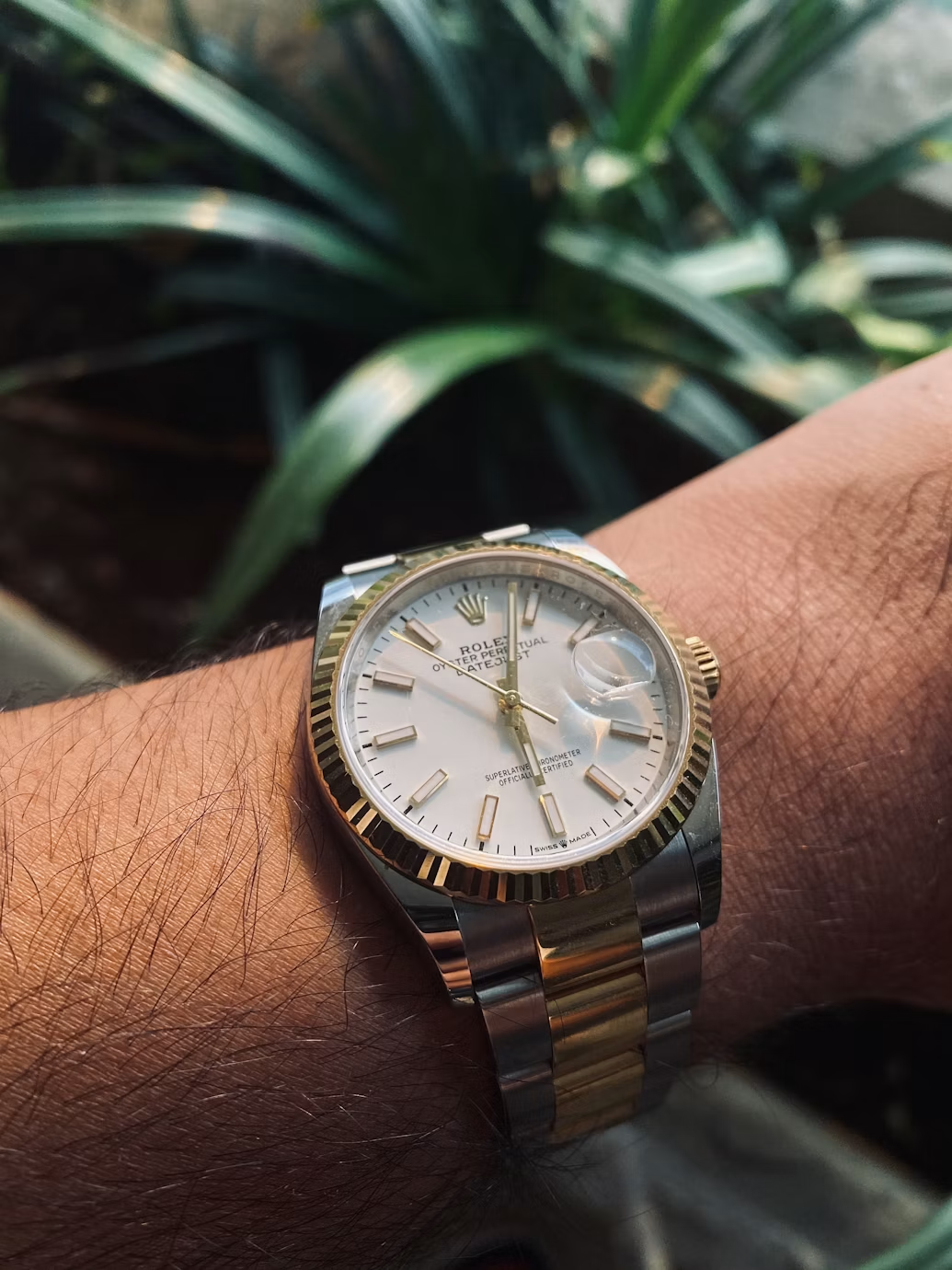
Rolex marked 100 years of the Oyster case this April with one dedicated anniversary edition, and it made that watch two-tone. If you want to know where two-tone watches stand in 2026, that decision is the whole story: the most conservative brand in Switzerland dressed its birthday watch in steel and yellow gold rather than platinum. Cartier and Piaget showed up in Geneva with the same idea. The part the market hasn’t digested is that several two-tone watches references still trade below retail. That gap is the opportunity, and I don’t expect it to survive the year.
Article Overview
Geneva went warm this spring
The anniversary piece is the Oyster Perpetual 41 “Oyster 100,” ref. 134303. Rolex kept the gold to a domed yellow-gold bezel and a winding crown with “100” in relief; case and bracelet stay Oystersteel. The slate sunray dial carries green accents on the minute track and “100 years” where “Swiss Made” normally sits. Inside is the calibre 3230, the standard no-date engine. Restraint is the point. For its own birthday, Rolex didn’t reach for a stone dial or a precious case, it reached for Rolesor.
| Reference | Oyster Perpetual 41 “Oyster 100” 134303 |
| Case | 41mm × 11.6mm, Oystersteel, yellow-gold bezel and crown |
| Dial | Slate sunray, green minute track |
| Movement | Calibre 3230, 70h reserve |
| Water resistance | 100m |
| Price | $9,650 list (April 2026) |
Cartier brought the Roadster back after a 14-year absence, and both sizes of the new collection (47 × 38mm large, 42.5 × 34.9mm medium) come in steel-and-yellow-gold alongside the plain steel and full gold versions. Steel starts at €9,300 for the medium and €10,200 for the large as of the April launch; Cartier hadn’t published two-tone pricing when the collection debuted. The bracelet takes QuickSwitch, so the two-tone head can sit on leather when the mixed metal feels like too much on a given day.
Piaget went furthest. The Polo 79 two-tone (ref. G0A51150, €96,000) is white gold with yellow-gold gadroons running through the case and bracelet, even the dial, 38mm across and 7.45mm thin on the micro-rotor calibre 1200P1. It reads as two-tone from across a room and costs what it costs. The original 1979 Polo came in mixed-metal versions too, so this is the least revisionist watch of the three.
“When Rolex makes its birthday watch steel and gold, mixed metal stops being a risk.”
The market case for two-tone watches in 2026
Solid gold is having a rough summer. Bloomberg’s Subdial Index report from July 9 found all 13 gold watches among the 50 most-traded models losing value since April; the 40mm gold Daytona on Oysterflex is down 4 percent to around $34,700 against a list price that starts at $42,700. The driver is bullion, off more than a fifth since February after the 2025 spike, and gold watches that gained 9 percent last year are now following the metal down. A full-gold watch is partly a commodities position, even if you never meant to take one.
Two-tone is mostly steel, so it moves on taste instead of the metals desk. And taste is repricing faster than the secondary market. The broad WatchCharts index is up more than 10 percent over the last year, yet the two-tone Datejust 41 ref. 126333 still changes hands around $14,800 against a $15,350 US list per WatchCharts’ 2026 data. The two-tone Explorer 36 sits about 30 percent under retail. In a rising market, the references attached to the trend everyone in Geneva just endorsed are the ones lagging.
The exception proves where this is heading. The GMT-Master II ref. 126713GRNR, the steel-and-yellow-gold GMT with the grey-and-black bezel, already trades around $20,854 against a $20,450 list (WatchCharts, June 2026). It’s a two-tone sports Rolex you cannot buy at a discount anymore. The quieter two-tone references haven’t followed yet.
What to buy
Datejust 41, ref. 126333. The default for a reason. A yellow-gold bezel and gold center links on Oystersteel, and the champagne or silver dials sit at the bottom of the $14,000–21,000 pre-owned range while fancier dials climb from there. Buying a couple of points under retail isn’t a steal, but for the reference that defines the category, paying less than list in a market up double digits is a fine trade. Take it on the Jubilee.
Explorer 36, ref. 124273. This is the one I’d actually buy. WatchCharts had it around $10,217 in June against $14,600 retail, a 30 percent gap on a current-production Rolex. It also happens to be 36mm at a moment when smaller cases are outperforming everything (the 35mm Nautilus 7118 has gained 52 percent in two years, nearly double the 40mm 5711’s rise). One of the few two-tone watches in the size the market is moving toward is about as aligned with the tape as a purchase gets.
GMT-Master II, ref. 126713GRNR. The momentum pick, already above retail and unlikely to retreat while it’s the two-tone sports flagship. With the Pepsi gone from the catalogue, the GMT line’s attention has to land somewhere, and the GRNR’s grey-and-black bezel on yellow gold is the most wearable current GMT for anyone whose wardrobe isn’t built around a red-and-blue bezel. You’re paying the trend premium here. At 2 percent over list, it’s still a small one.
Polo 79 two-tone, ref. G0A51150. For one buyer in a hundred, but that buyer gets the best object of the four. All-precious-metal two-tone, 7.45mm thin, and a shape nobody will mistake for a Datejust at €96,000. This is the watch the other three are gesturing at.
Wearing it without the yacht
The old objection to two-tone watches was that it dressed like 1980s money. That association died when the steel-sports uniform became the cliché instead; a two-tone Datejust now reads as the more independent choice. Let it be the only metal event on your wrist and it works with knitwear and denim as easily as tailoring. What kills it is competition, a gold bracelet stacked next to it, or a second watch-adjacent thing on the other wrist.
The practical call: buy the Explorer 124273 before the repricing reaches it. The GRNR already shows you the destination.
