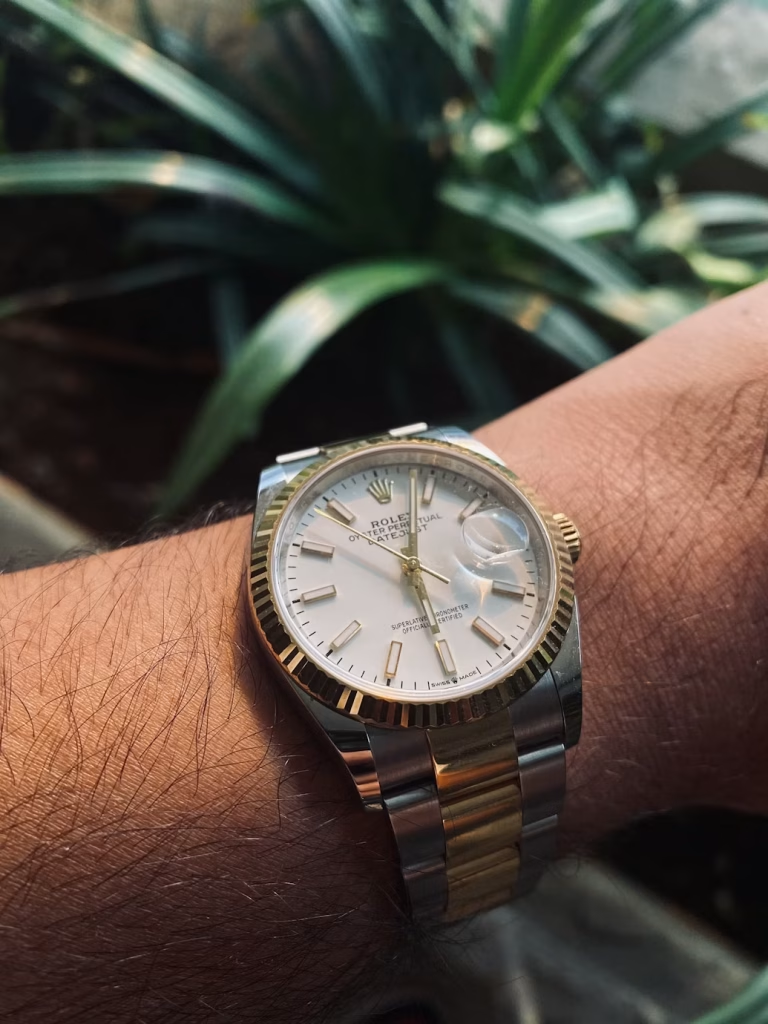
The 36mm watch comeback stopped being a prediction some time last year. Watches and Wonders 2026 gave A. Lange & Söhne’s Saxonia Annual Calendar a 36mm case, put Bulgari’s Octo Finissimo at 37mm, and shrank IWC’s Big Pilot Perpetual Calendar to 42mm from north of 46mm. Even Grand Seiko’s new Ushio 300 diver landed under 41mm. The 42-to-44mm decade is finished.
Which means the interesting question is no longer whether to take small watches seriously. If you already own a 40mm steel sports watch and you’re eyeing something smaller, the question is what sizing down actually costs you. Two of the three answers have nothing to do with how the watch looks.
Article Overview
The 36mm watch comeback is measured with the wrong number
Diameter is the number brands print and the number everybody repeats, and it’s close to useless on its own. Lug-to-lug decides whether a watch sits on your wrist or hangs off it. Case height decides whether it slides under a cuff. Diameter mostly decides how big the dial looks.
Compare four watches that all get called small.
| Rolex Explorer 36 (124270) | 36mm · 43mm lug-to-lug · 11.5mm thick · 19mm lugs |
| Tudor Black Bay 54 | 37mm · 45.6mm lug-to-lug · 11mm thick · 20mm lugs |
| Omega Aqua Terra 38 | 38mm · 45.1mm lug-to-lug · 12.3mm thick |
| Omega Aqua Terra 41 | 41mm · 48mm lug-to-lug · 13.4mm thick |
The Black Bay 54 is a millimetre wider than the Explorer and 2.6mm longer across the lugs. It’s also longer than the 38mm Aqua Terra, a watch two millimetres bigger on paper. Watch Clicker’s review put it plainly after measuring one: the 54 “feels a lot bigger than 37mm”. That isn’t a criticism of the watch, which is superb, and at 11mm it’s flatter than almost anything in its class. It’s a warning about the spec sheet.
A 37mm diver with 45.6mm of lug-to-lug wears like a 40mm watch that happens to have a small dial.
If your wrist is flat and under about 6.5 inches, the constraint is lug-to-lug, full stop. Buy on that number and the diameter takes care of itself. This is the same lesson as choosing between a titanium and a steel diver, where the metal changes the wearing experience more than the dimensions do.
Nineteen millimetres
Here’s the cost nobody prices in. When Rolex brought the Explorer back to 36mm in 2021 with the 124270, it narrowed the lugs from 20mm to 19mm. The reasoning is defensible, thicker lugs, a case that doesn’t read as dainty, and on the bracelet it’s excellent. The consequence is that you have bought into the single most annoying strap size in watchmaking.

Nineteen millimetres is not 18 and it is not 20. Strap sellers file it under “most common Explorer buying mistake” because people order 20mm out of habit. The aftermarket exists, but it’s a fraction of the size of the 20mm market, and the good makers stock it in two colours instead of twelve. The previous 36mm Explorer, the 114270, took 20mm lugs and you could put anything on it.
Sizing down often means sizing into an odd lug width, because narrower cases get narrower lugs. Check the number before you buy, not after. If you’re the sort of person who rotates straps by season, a 19mm watch will quietly become a bracelet-only watch.
The market repriced small before you got there
The trend pieces argue this qualitatively. SwissWatchExpo’s January 2026 case for the 36mm revival names the Explorer I, the Datejust 36, the Santos Medium and the 37mm Royal Oak, and cites no market data at all. The data exists, though, and it says the trade already happened.
The WatchCharts Overall Market Index rose more than 10% in the year to May 2026 after three flat years, with Patek up 18%, Rolex and Cartier both up 9%. Inside that recovery, small outperformed hard. The 35mm Nautilus 7118 gained 52% in the two years to May 2026. The 40mm 5711, the reference that made the collection famous, gained 27% over the same stretch. On the Rolex side, the 36mm Datejust ref. 16030 was up more than 29% across 2026 so far, to an average of $7,195.
That’s a real move, and it is not a reason to buy. It’s the opposite. Buying a category after it has outrun its larger siblings by 25 points is paying for a preference that’s already consensus. The 36mm vintage Datejust was the cheap way into Rolex for two decades precisely because nobody wanted it; that discount is spent. Anyone treating small cases as a value play should read what actually holds value in 2026 first, because the answer is rarely whatever the fair just decided it likes.
Where sizing down costs you nothing
Current production is a different story, and this is the useful part. As of June 2026 the Explorer 36 retails at $7,900 and trades around $7,848 on the secondary market, essentially parity. The Explorer 40 sits at $8,350 retail and trades near it. Neither size carries a premium, and neither punishes you for choosing it. Rolex prices the 36 lower and the market agrees by roughly the same margin, which is about as rational as this hobby gets.
The Black Bay 54 behaves the same way, tracking close to its retail since launch, around $4,725 on the bracelet in July 2026. Buy the small one because it fits, not because someone told you it’s an investment, and current-production references will not charge you for the decision.
Where the modern 36mm case genuinely beats its predecessor is inside. The 124270 runs the calibre 3230 with a 70-hour reserve, against 48 hours from the 3130 in the old 114270, and it’s a full half-millimetre thinner. You are giving up nothing mechanical by going down.
What I’d actually buy
If you already own a 40mm sports watch and want the second one to feel different, go to 36mm rather than 38mm. Thirty-eight is close enough to your existing watch that you’ll wonder why you bothered, and the Aqua Terra numbers above show how little the case shrinks between the two sizes. Thirty-six changes the wrist.
If it’s your only watch, look at lug-to-lug and stop looking at diameter. Under 44mm across the lugs works on almost everyone, and it’s the reason the Explorer 36 gets recommended to people with 7.5-inch wrists without it being a joke. Then check the lug width, decide whether you can live on a bracelet, and buy on fit. A watch that goes on every morning is worth more than one that was the correct size according to a fair in Geneva. Same logic that decides whether your first serious watch should be a sports or dress piece — range beats fashion, every time.