The honest answer to sports watch vs dress watch, if you’re buying one watch and want it to work everywhere, is the sports watch. Not because it’s better made, and not because dress watches are somehow lesser. It’s arithmetic. A good steel sports watch is comfortable at a desk, fine if it rains, happy on a weekend, and not remotely absurd under a jacket. A dress watch does exactly one job, beautifully, and sits in a drawer the other six days.
That’s the whole argument. Everything below is the detail that decides when the rule flips.
Article Overview
Sports watch vs dress watch is really about range
People frame this as formal versus casual, which misses the point. The useful distinction is range. A dress watch is a specialist: thin case, small seconds or no seconds, leather strap, water resistance measured in “don’t.” It’s built to disappear under a cuff and look correct with a suit, and it is very good at that and nothing else. Get it wet, knock it on a doorframe, or wear it with a t-shirt and it looks either fragile or fussy.
A sports watch carries more tolerance. Steel bracelet or rubber, 100 metres or more of water resistance, a movement that shrugs off the day. The good ones have learned to dress up. That’s the reason they win the one-watch slot for most people, and it’s worth seeing where the money actually goes before you commit.
Why a sports watch wins the one-watch slot
Take the Omega Aqua Terra 150M. As of July 2026 it’s around US$6,200 for the 38mm on bracelet, a bit more for the 41. For that you get 150m of water resistance, a METAS-certified Master Chronometer movement, and a dial clean enough to pass at a wedding. It swims, it works at the office, it goes out on the weekend, and you never change a strap or think about the crown. That’s the pitch for the whole category in one reference.
Prefer something with more attitude and a lower entry price? The Tudor Black Bay 58 starts at $4,975 on rubber and $5,350 on the bracelet as of 2026. It’s a dive watch by build, but at 39mm it wears small enough to slide under a cuff, which the older 41mm divers never quite managed. Either of these is a watch you can wear for a decade without wishing you’d bought something for the days the other one can’t handle.
The point isn’t these two specifically. It’s that the sports category gives you a watch with no off-days. A dress watch, by design, has five of them a week.
When a dress watch is the right call
Two situations flip the rule.
The first is a genuinely formal life. If you’re in tailoring most days, in rooms where a rubber-strapped diver reads as wrong, the specialist stops being a luxury and becomes the correct tool. A slim dial under a shirt cuff is the point, not a compromise.
The second is the second watch. Once you own something that covers Monday through Sunday, a dress watch is a wonderful next purchase, precisely because it does the one thing your daily can’t. And the entry here is gentler than people assume. A Longines DolceVita runs about $1,650 to $1,800 as of July 2026, available in quartz or automatic. A Cartier Tank Must starts near $3,300 on quartz. Step up to a Jaeger-LeCoultre Reverso and you’re at roughly $7,500 and into real mechanical interest, with the reversible case nothing else offers.
None of those wants to be your only watch. All of them are superb as the second.
The mistake most people make going dress-first
The trap is usually about price. A dress watch photographs beautifully and often costs less than the sports equivalent, so it’s an easy first purchase to talk yourself into. Then it lives in a drawer. You reach for it twice a year, feel a small pang of guilt, and eventually buy the everyday watch you should have started with, now with less money to spend on it.
The other version is the size trap. Dress watches run thin and often small, 36mm and under, which is right for the genre and wrong for a lot of wrists that have spent a decade on 40mm sports watches. Try one on before you assume the classic proportion suits you. It can read as tiny on a wrist used to a diver, and no strap change fixes case diameter.
Buy the watch you’ll actually put on tomorrow morning. For most people that’s the sports watch, and the drawer stays empty.
The hybrid that dodges the whole question
There’s a third door, and plenty of people walk through it: buy something that refuses to pick a side. Robust elegance is the trade term. A watch with a versatile dial, mixed finishing, 100m or more of water resistance, and nothing so sporty it can’t dress up.
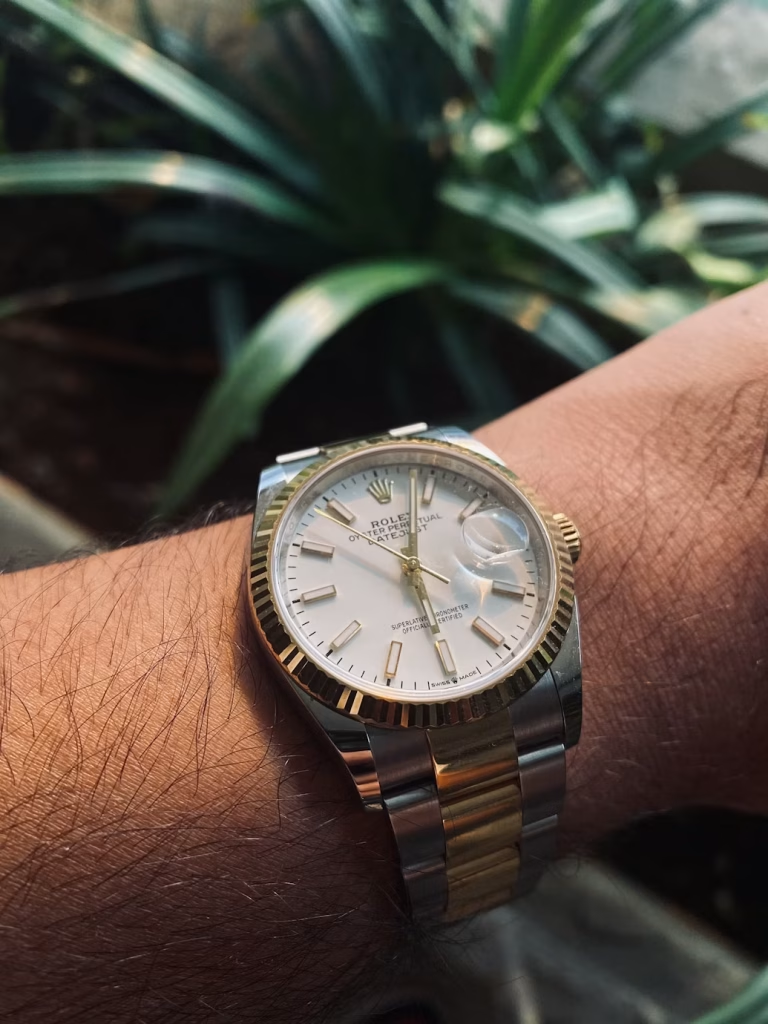
The Rolex Datejust is the archetype. The 36mm in steel is around $8,150 as of July 2026, the 41 a little more. It has a date and a clean dial and a bracelet, and it is equally unremarkable in the best sense at a funeral or a Friday night. It won’t out-swim the Aqua Terra or out-dress the Reverso. It just never looks wrong, which for one watch is the entire game.

| Everyday sports pick | Omega Aqua Terra 150M — ~$6,200 (38mm, July 2026) |
| Value sports pick | Tudor Black Bay 58 — $4,975 rubber (2026) |
| Entry dress pick | Longines DolceVita — ~$1,650-1,800 (July 2026) |
| Hybrid escape hatch | Rolex Datejust 36 — ~$8,150 steel (July 2026) |
So: if this is your first and possibly only watch, buy the sports watch, or buy the hybrid and stop reading buying guides. Save the dress watch for when you already own something you can wear every day, then buy the most interesting one your budget allows, because at that point it only has to be beautiful.